
Human-Centred and Social Design: Creating Inclusive Spaces, Products and Community Experiences
Design affects how people move, communicate, learn, work, receive services and participate in society. A building entrance can either support independent access or create a physical barrier. A public sign can guide people confidently or exclude those who cannot understand its language, scale or symbols. A digital service can make essential information readily available or make it inaccessible to users with visual, cognitive, linguistic or technological limitations.
These outcomes demonstrate that design is never entirely neutral. Every decision about space, materials, interfaces, communication, cost and accessibility influences who can participate and under what conditions.
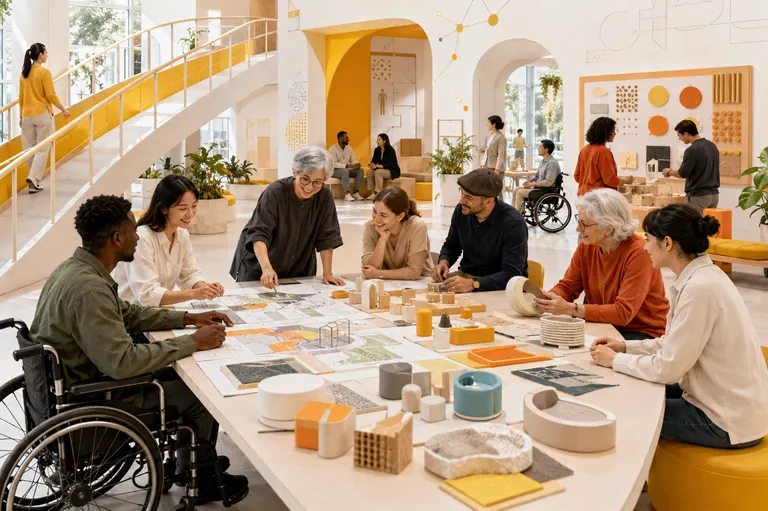
Human-centred and social design respond to this responsibility by placing people, communities and lived experience at the centre of creative enquiry. Instead of beginning with a predetermined object or visual solution, these approaches begin by examining real environments, unmet needs, social relationships and the barriers people encounter.
For the International Journal of Arts Architecture & Design, this field is particularly relevant because it connects architecture, interiors, product design, graphic communication, user experience, digital arts, cultural practice and creative education. It also encourages interdisciplinary research linking design with sociology, public health, psychology, disability studies, community development and public policy.
What Is Human-Centred Design?
Human-centred design is an approach to understanding problems and developing solutions through close engagement with the people affected by design decisions. It involves observation, research, participation, prototyping, testing and revision.
The process does not assume that designers already know what people need. Instead, it treats users and stakeholders as sources of knowledge about their own experiences.
The Design Council argues that human-centred design should account for every person affected by a design decision, not only the most obvious end user. These people may include manufacturers, installers, maintenance workers, caregivers, delivery personnel and those responsible for reuse or disposal. Its guidance also emphasises observing people in real settings and testing ideas with actual users. Design Council’s human-centred design principles.
A robust human-centred process typically includes:
- Understanding people within their actual environments
- Identifying visible and hidden barriers
- Questioning assumptions held by the design team
- Including diverse users in research
- Developing multiple concepts
- Creating prototypes
- Testing with intended participants
- Revising the design based on evidence
- Evaluating outcomes after implementation
The objective is not simply to ask people whether they like a design. It is to understand how the design affects their independence, dignity, safety, comfort and ability to participate.
What Is Social Design?
Social design applies creative methods to social challenges and collective experiences. It may address public health, education, housing, environmental justice, community resilience, mobility, public services, cultural participation or social isolation.
While human-centred design may focus on the interaction between people and a product, space or service, social design frequently examines the wider system around that interaction.
For example, redesigning a public-health information poster is a communication-design task. Understanding why health information fails to reach certain communities requires a social-design perspective. Researchers may need to examine language, trust, literacy, access to services, cultural beliefs, distribution systems and relationships between institutions and communities.
Social design therefore asks broader questions:
- Who defines the problem?
- Whose knowledge is considered valid?
- Who participates in decision-making?
- Which groups benefit from the proposed solution?
- Could the design unintentionally create new exclusions?
- Can the community maintain or adapt the intervention?
- Which institutional conditions affect success?
- How should social outcomes be evaluated?
The strongest social-design projects do not treat communities as passive recipients. They create meaningful opportunities for community members to influence priorities, methods and outcomes.
Human-Centred, Inclusive, Universal and Participatory Design
These terms are related, but they are not identical.
Human-Centred Design
Human-centred design studies people’s needs, behaviours and environments throughout the design process. It can be applied to spaces, products, services, systems and digital experiences.
Inclusive Design
Inclusive design recognises human diversity and seeks to prevent exclusion. It considers differences in physical ability, sensory experience, cognition, age, language, culture, income, gender, education and access to technology.
Universal Design
Universal design seeks to create environments, products and services that can be used by as many people as possible without requiring separate or specialised solutions. It does not eliminate every need for individual accommodation, but it reduces avoidable barriers from the beginning.
Participatory Design
Participatory design actively involves affected people in developing a solution. Participants may help identify problems, generate ideas, evaluate prototypes and make decisions.
Social Design
Social design addresses relationships, institutions and systems that influence collective well-being. It may use human-centred, inclusive and participatory methods, but its objective is generally broader than improving an individual interaction.
These approaches can reinforce one another. An inclusive public library, for example, may be developed through participatory workshops, tested using human-centred methods, guided by universal-design principles and evaluated as a social resource for the entire community.
Why Inclusive Design Is an Urgent Research Priority
The World Health Organization estimates that approximately 1.3 billion people, representing around 16% of the global population, experience significant disability. WHO also notes that disability results from interactions between health conditions and environmental or personal factors. Inaccessible transport, information, facilities and services can therefore intensify exclusion. WHO disability and health overview.
This has a direct implication for designers: disability is not located only within an individual. It can also be produced or intensified by environments that fail to accommodate human variation.
A person using a wheelchair is excluded by stairs without an accessible alternative. A person with limited vision is excluded when information depends on low-contrast text. A person with hearing loss may be excluded when announcements are provided only through audio. Someone with a cognitive disability may struggle with unnecessarily complex forms, instructions or navigation.
Inclusive design is consequently not a specialist concern relevant only to a small group. It is a fundamental issue for architecture, product design, communication and digital systems.
Designing Inclusive Spaces
Buildings and public spaces shape participation in education, work, healthcare, culture and community life. Accessibility must therefore be considered at the earliest planning stage.
Moving Beyond Minimum Compliance
Building codes establish essential requirements, but compliance does not always guarantee a usable or dignified experience. A ramp may technically exist while being too distant, steep or poorly maintained. An accessible toilet may be used for storage. Tactile paving may lead into an obstruction. A lift may be available but difficult to locate.
Human-centred architectural research examines the complete journey through a space. This includes arrival, entrance, circulation, orientation, use of facilities, emergency evacuation and departure.
Researchers can investigate:
- Step-free access and continuous accessible routes
- Door dimensions and operating force
- Lift location and reliability
- Accessible toilets and changing facilities
- Seating for varied bodies and mobility needs
- Lighting and visual contrast
- Tactile and audible navigation
- Acoustic quality
- Sensory-responsive spaces
- Accessible emergency systems
- Inclusive parking and transport connections
- Resting points and shaded waiting areas
Inclusive Educational Environments
Schools, universities and design studios must support students with different physical, sensory, cognitive and learning needs. An inclusive campus is not created simply by adding a ramp to the main entrance.
Research may examine classroom layouts, studio furniture, lighting, acoustics, digital learning platforms, laboratory access, signage and assessment spaces. Researchers can also investigate how spatial design influences participation, belonging and social interaction.
Healthcare and Therapeutic Environments
Healthcare spaces require particular sensitivity because users may be anxious, unwell, fatigued or unfamiliar with the environment. Clear navigation, privacy, accessible examination facilities, reduced sensory stress and supportive waiting spaces can influence the quality of care.
Human-centred research can include patients, caregivers, clinical staff, maintenance teams and visitors. Each group experiences the environment differently.
Inclusive Public and Cultural Spaces
Museums, galleries, theatres, parks and community centres play an important role in cultural participation. Inclusive design may involve step-free routes, touchable interpretations, captioning, audio description, quiet spaces, multilingual information and flexible seating.
The research question should extend beyond whether people can enter. It should examine whether they can participate meaningfully and independently.
Designing Products for Human Diversity
Product design often assumes an idealised user with typical strength, vision, dexterity, literacy and technological confidence. Real users are far more diverse.
Inclusive product design considers differences in hand size, grip strength, reach, mobility, perception, memory and experience. These considerations can improve products for a broad population, including children, older adults, injured users and people operating under temporary constraints.
Everyday Product Accessibility
Researchers may evaluate:
- Grip shape and operating force
- Button size and spacing
- Tactile differentiation
- Visual contrast
- Feedback through sound, touch or light
- Clear assembly and operating instructions
- One-handed operation
- Error prevention
- Ease of cleaning and maintenance
- Repairability
- Safe use by people with limited mobility or vision
A product should be tested in the context where it will be used. Laboratory testing alone may not reveal difficulties created by poor lighting, noise, time pressure or limited space.
Adaptive and Assistive Products
Assistive products can support mobility, communication, self-care, education and independent living. However, technically functional products may still be rejected if they are uncomfortable, socially stigmatising, unaffordable or difficult to maintain.
Research should consider aesthetics, identity and emotional experience alongside function. Users may want products that express personal style rather than announcing a medical condition.
Affordability as a Design Requirement
A product cannot be socially inclusive if intended users cannot afford to purchase, repair or replace it. Researchers should examine local manufacturing, modular repair, material selection and distribution models.
Affordability should not result in unsafe or visually inferior products. Socially responsible design seeks appropriate quality, dignity and long-term value within realistic economic conditions.
Inclusive Communication and Information Design
People depend on visual and digital communication to access transport, healthcare, education, public programmes and emergency information. Poor information design can create barriers as serious as inaccessible architecture.
Wayfinding and Public Information
Effective wayfinding combines typography, symbols, colour, lighting, spatial landmarks and consistent placement. It should support people who are unfamiliar with the environment, have limited literacy or speak different languages.
Researchers can evaluate:
- Legibility at realistic viewing distances
- Contrast under different lighting conditions
- Comprehension of symbols
- Multilingual information
- Placement at decision points
- Tactile and audible alternatives
- Navigation for people with cognitive disabilities
- Integration with mobile guidance systems
Wayfinding should be tested through observed journeys rather than evaluated only as a graphic composition.
Plain Language and Cognitive Accessibility
Complex language can prevent people from understanding essential information. Instructions, consent forms, public notices and digital interfaces should use clear wording and logical sequencing.
Cognitive accessibility may include:
- Short and direct sentences
- Consistent terminology
- Clear headings
- Supportive icons
- Progressive disclosure of information
- Error-tolerant forms
- Predictable navigation
- Sufficient time to complete tasks
- Alternatives to memory-dependent interaction
Clarity is not a reduction in intellectual quality. It is a design decision that improves access.
Human-Centred Digital and UX Design
Digital systems increasingly determine how people apply for services, access knowledge, make payments and communicate with institutions. When these systems are inaccessible, people may lose access to opportunities or essential support.
Accessibility From the Beginning
Accessibility is most effective when integrated into research, interface architecture, content and testing from the start. Adding it after development may leave structural barriers unresolved.
Researchers can examine:
- Keyboard navigation
- Screen-reader compatibility
- Alternative text
- Colour contrast
- Captioning and transcripts
- Scalable typography
- Touch-target dimensions
- Simple authentication processes
- Error identification and recovery
- Performance on low-cost devices
- Operation with slow or unstable internet
- Multilingual and voice-based access
Digital Exclusion Is More Than Interface Design
A well-designed application may still exclude people who lack a reliable device, internet connection, digital literacy or private space. Human-centred research should therefore examine the complete service system.
Researchers should ask whether an offline or assisted route remains available. Requiring every person to use a smartphone can transfer institutional responsibility onto users who have the fewest resources.
Artificial Intelligence and Inclusive Experience
AI can support translation, personalised interfaces, speech recognition and assistive technologies. It can also reproduce bias or make automated decisions that users cannot understand or challenge.
Research priorities include the accessibility of AI interfaces, bias in training data, transparency, cultural representation and the ability of users to correct automated outcomes.
Participatory and Co-Design Methods
Participation can improve relevance by incorporating knowledge that professional teams do not possess. However, participation must be designed carefully.
Levels of Participation
Not every consultation process gives participants genuine influence. Community members may be asked for opinions after major decisions have already been made.
Meaningful participation can involve communities in:
- Defining the research problem
- Identifying priorities
- Selecting research methods
- Generating design concepts
- Developing prototypes
- Testing alternatives
- Choosing between proposals
- Implementing the intervention
- Evaluating outcomes
- Governing future adaptation
Researchers should report which decisions participants could influence and which remained under institutional control.
Selecting Participants Responsibly
Convenience samples often include people who are already visible, confident or connected to institutions. This can exclude those most affected by a problem.
Recruitment should consider age, gender, disability, language, income, location and social position. Researchers may need accessible venues, transport support, translated materials, flexible timings or compensation for participation.
Respecting Community Knowledge
Participants should not be treated merely as free sources of information. Researchers should consider attribution, ownership, consent and how findings will be returned to the community.
When local craft, cultural or indigenous knowledge influences a design outcome, clear agreements may be needed concerning recognition and future use.
Social Design for Community Experiences
Community experience is shaped by more than physical appearance. It emerges from relationships between people, places, services and institutions.
Public Spaces and Social Connection
Parks, streets, markets, libraries and community centres can encourage interaction, recreation and civic participation. Their success depends on access, safety, comfort, programming and long-term management.
Researchers can study:
- Who uses a space and who does not
- How use changes by time and season
- Gendered experiences of safety
- Accessibility for children and older adults
- Informal economic activity
- Availability of shade, seating and toilets
- Cultural uses of shared space
- Effects of maintenance and policing
- Relationships between design and social interaction
A visually impressive public space may remain socially unsuccessful if communities feel unwelcome or cannot influence how it is managed.
Designing With Informal and Marginalised Communities
Social design frequently operates in contexts where formal services are limited. Designers must avoid approaching these communities only through narratives of deficiency.
Residents often possess extensive knowledge about local networks, risks, resources and coping strategies. Research should identify existing strengths and support community agency.
Projects may address housing improvements, sanitation, mobility, education, waste management or public health. Long-term success depends on affordability, governance and maintenance as much as the physical design.
Cultural Participation and Belonging
Art, performance, craft and storytelling can strengthen community identity and create spaces for dialogue. Social design can support participatory exhibitions, community archives, public art and intergenerational knowledge exchange.
Researchers should examine who controls representation. A cultural project should not simplify community identity for an external audience or exclude disagreement within the community itself.
From Individual Products to Systems
Many social problems cannot be solved through a single object or interface. Transport exclusion, housing insecurity, poor public health and unequal education are shaped by policies, institutions, infrastructure and economic conditions.
The Design Council defines systemic design as an approach that recognises complexity and interconnectedness throughout design activity. Its framework encourages designers to explore, reframe, create and catalyse change while considering relationships and structures around a challenge. Systemic Design Framework.
Systems thinking encourages researchers to map:
- Stakeholders and decision-makers
- Formal and informal relationships
- Flows of money, information and resources
- Policies and institutional responsibilities
- Incentives and power differences
- Causes of exclusion
- Potential unintended consequences
- Opportunities for long-term change
This approach does not reduce the importance of well-designed products or spaces. It helps ensure that these interventions address an appropriate part of the wider problem.
Research Methods for Human-Centred and Social Design
Research methods should be selected according to the question, context and participants.
Observation and Contextual Enquiry
Observation reveals behaviours that participants may not mention in interviews. Researchers can study how people navigate buildings, adapt products, seek assistance or respond to information.
Observation must be conducted ethically. Participants should understand the research, particularly in private or sensitive settings.
Interviews and Focus Groups
Interviews provide insight into experience, priorities and meaning. Focus groups can reveal shared concerns and differences within a community.
Researchers should use accessible language and avoid questions that direct participants towards a preferred answer.
Cultural Probes and Visual Methods
Diaries, photographs, maps, drawings and object-based activities can help participants communicate experiences that are difficult to express verbally. These methods are especially useful in design, community and cross-cultural research.
Journey Mapping and Service Blueprinting
Journey maps document the stages through which a person interacts with a service or environment. Service blueprints connect visible experiences with staff actions, systems and institutional processes.
These tools should be based on research evidence rather than invented personas or assumptions.
Prototyping and Usability Testing
Prototypes allow ideas to be examined before full implementation. They may range from paper sketches and cardboard models to digital interfaces and full-scale spatial mock-ups.
Testing should include diverse users and realistic tasks. Researchers should document failures and revisions, not only the final successful version.
Participatory Action Research
Participatory action research involves communities in investigating conditions and taking action. It is particularly relevant when research seeks practical and social change.
This method requires careful attention to shared decision-making, researcher power, community expectations and the sustainability of outcomes.
Ethical Responsibilities in Social Design Research
Human-centred research often involves personal experiences, disability, health, income, housing or identity. Ethical responsibility therefore extends beyond obtaining a signed consent form.
Researchers should address:
- Voluntary and informed participation
- Accessible consent processes
- Privacy and confidentiality
- Emotional or social risk
- Fair participant compensation
- Cultural sensitivity
- Protection of vulnerable participants
- Ownership of community-generated materials
- Honest communication about project limitations
- Responsible use of photographs and recordings
- Avoidance of extractive research relationships
Researchers should not promise that every design proposal will be implemented. Expectations must be managed transparently.
Measuring Social and Inclusive Design Outcomes
Social impact is difficult to measure because change may emerge gradually and be influenced by many factors. However, this difficulty should not justify vague claims.
Evaluation may include:
- Increased independent access
- Reduced task completion time
- Lower error rates
- Improved comprehension
- Greater participation
- Increased feelings of safety or belonging
- Reduced need for assistance
- Improved service access
- User satisfaction
- Long-term adoption
- Community capacity
- Maintenance and continuity after the project ends
Quantitative indicators can be combined with interviews, observations and participant narratives. Longitudinal evaluation is valuable because an intervention that performs well during launch may become ineffective without maintenance or institutional support.
Researchers should also identify unintended effects. A redesigned public space may increase activity while displacing informal vendors. A digital service may improve speed for some users while removing face-to-face access for others.
Research Priorities for 2026 and Beyond
Important research directions include:
- Inclusive public spaces for diverse ages, genders and abilities
- Accessible and affordable housing
- Human-centred healthcare environments
- Inclusive products for ageing populations
- Assistive products without social stigma
- Accessible digital public services
- Inclusive UX for low-literacy and multilingual users
- AI, bias and accessibility
- Participatory urban and community design
- Social design for climate resilience
- Inclusive cultural and museum experiences
- Community-led heritage documentation
- Sensory-responsive educational environments
- Accessible transportation and wayfinding
- Evaluation of social-design outcomes
- Ethics and power in co-design
- Gender-responsive public-space design
- Design for informal settlements and underserved communities
These subjects require collaboration among designers, architects, artists, technologists, social scientists, healthcare professionals, policymakers and communities.
Preparing a Strong Research Manuscript
Researchers intending to publish work on human-centred or social design should clearly explain:
- The social or design problem
- The population or community affected
- The context in which the problem occurs
- The theoretical or methodological foundation
- How participants were recruited
- How accessibility and consent were addressed
- Which research and design methods were used
- How participant input influenced decisions
- How the outcome was evaluated
- What limitations remain
- How the study contributes to knowledge and practice
Visual evidence such as plans, prototypes, journey maps, photographs and diagrams should support the argument. Images involving participants require appropriate permission and ethical handling.
Role of the International Journal of Arts Architecture & Design
Human-centred and social design sit naturally at the intersection of architecture, product design, interiors, graphic communication, user experience, digital media and social research. This makes the field highly relevant to the interdisciplinary scope of the International Journal of Arts Architecture & Design.
The journal can provide a scholarly platform for:
- Inclusive architecture and interior-design research
- Accessible products and assistive technologies
- Participatory and community-based design
- Social innovation
- Inclusive digital interfaces
- Public-space research
- Service-design studies
- Community arts and cultural participation
- Human-centred design education
- Critical studies of ethics, power and representation
Researchers, educators and practitioners are encouraged to develop submissions that combine creative enquiry with transparent methods, ethical participation and evidence of human or community relevance.
Frequently Asked Questions
What is human-centred design?
Human-centred design is an approach that develops products, spaces, services or systems through close study of the people affected by them. It uses research, participation, prototyping and testing to ensure that design decisions respond to real needs and environments.
What is social design?
Social design applies creative methods to collective challenges such as housing, healthcare, education, accessibility, community development and public participation. It considers both individual experience and the larger systems that shape that experience.
What is the difference between human-centred design and social design?
Human-centred design usually focuses on understanding people’s needs and interactions with a design. Social design has a broader focus on social relationships, institutions, equity and community outcomes. A project may use both approaches.
Why is inclusive design important?
Inclusive design reduces barriers experienced by people with different physical, sensory, cognitive, linguistic, cultural and economic conditions. It improves access, independence, safety and dignity while often producing better experiences for everyone.
Is inclusive design only for people with disabilities?
No. It benefits people with disabilities, but it also supports children, older adults, people with temporary injuries, users with limited literacy, speakers of different languages and people accessing services through constrained technology.
What is participatory design?
Participatory design involves the people affected by a design in identifying problems, generating ideas, evaluating prototypes or making decisions. It recognises participants as contributors to knowledge rather than only research subjects.
How can designers create more inclusive public spaces?
Designers can study the complete user journey, involve diverse communities, provide step-free access, suitable seating, clear wayfinding, lighting, shade, accessible facilities and flexible spaces. Inclusion should be evaluated through real use after completion.
Which methods are suitable for social-design research?
Useful methods include observation, interviews, focus groups, co-design workshops, journey mapping, cultural probes, prototyping, usability testing, ethnography and participatory action research.
How should the impact of social design be measured?
Impact can be evaluated through accessibility, participation, comprehension, independence, safety, belonging, service use and long-term adoption. Quantitative evidence should often be combined with interviews, observation and community feedback.
Can human-centred and social-design research be submitted to the International Journal of Arts Architecture & Design?
Research aligned with the journal’s scope may be considered through its established editorial and peer-review process. Authors should review the aims, scope, ethical policies and current author guidelines before submission.
Conclusion
Human-centred and social design require more than empathy as a general intention. They require systematic research, meaningful participation, ethical responsibility and careful evaluation.
Inclusive spaces must support complete journeys rather than isolated accessibility features. Products should respond to diverse bodies, capabilities and economic conditions. Digital experiences must account for disability, language, connectivity and digital confidence. Community projects must recognise local knowledge and give participants meaningful influence over decisions.
Design becomes socially valuable when it improves people’s ability to participate with independence, safety and dignity. It becomes academically valuable when those improvements are investigated through transparent methods and supported by credible evidence.
By encouraging interdisciplinary scholarship across architecture, product design, communication, user experience and creative practice, the International Journal of Arts Architecture & Design can contribute to a more inclusive understanding of design. Researchers and practitioners are invited to develop studies that place people and communities at the centre while critically examining the systems that shape everyday experience.
Universities, design schools and scholarly organisations planning to establish or modernise a journal can also seek professional support for journal websites, manuscript submission, editorial workflow, ISSN readiness and DOI planning. ScholarJMS supports integrated journal management, while OJSCloud, GetDOI and Scholar9 provide complementary support for publishing infrastructure, DOI workflows and research trust. Contact inquiry@ojscloud.com or WhatsApp +91 82003 85143.