
Emerging Research Trends in Arts, Architecture and Design in 2026: Generative AI, Sustainability, Cultural Heritage and Human-Centred Innovation
Arts, architecture and design research is entering a period of significant transformation. Creative disciplines are no longer concerned only with producing objects, images, buildings or performances. Researchers are increasingly examining how creative practice interacts with artificial intelligence, climate change, cultural identity, public well-being, digital participation and rapidly changing social systems.
In 2026, some of the most important research questions are emerging at the intersections between disciplines. An architectural project may simultaneously involve climate science, material innovation, community participation and cultural heritage. A digital artwork may raise questions about authorship, algorithmic bias, intellectual property and artistic labour. A product or service may need to be functional, environmentally responsible, accessible and culturally appropriate.
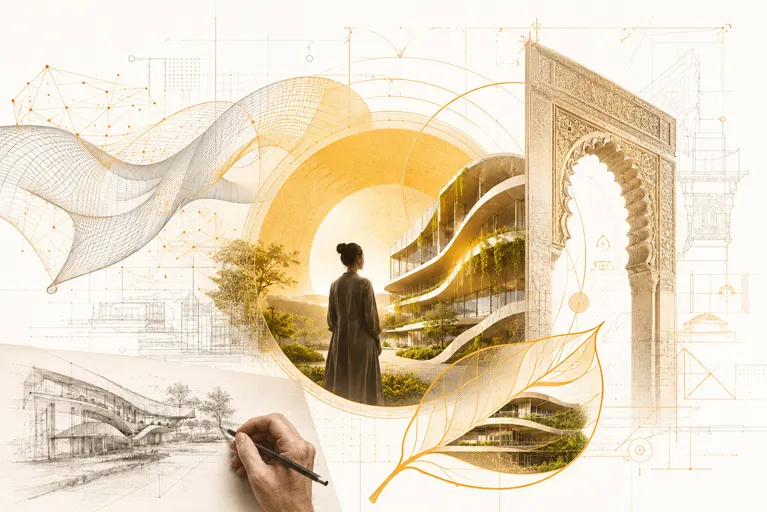
These developments are highly relevant to the International Journal of Arts Architecture & Design, which supports original and rigorous enquiry across visual arts, performing arts, architecture, interior design, industrial design, digital arts, fine arts, film, photography, fashion, textiles, product design, graphic communication, animation, game design and user experience design. The journal’s interdisciplinary positioning makes it particularly suitable for research that connects creative practice with technological, environmental, cultural and human concerns.
This article examines the major research trends likely to shape arts, architecture and design scholarship throughout 2026 and beyond.
Why Arts, Architecture and Design Research Is Becoming More Interdisciplinary
Traditional academic boundaries are becoming less effective for understanding contemporary creative challenges. Climate-responsive architecture cannot be studied adequately without considering materials, energy, human behaviour and local ecology. Digital heritage cannot be separated from questions of community ownership, archival ethics and technological access. Human-centred design increasingly requires insights from sociology, psychology, public health and disability studies.
This does not mean that specialist knowledge is becoming less important. It means that specialist knowledge must be connected more carefully with other forms of expertise.
For researchers, this interdisciplinary environment creates opportunities to:
- Combine practice-based and conventional research methods
- Connect creative work with measurable social or environmental outcomes
- Study relationships between technology, culture and human experience
- Build collaborations across departments and institutions
- Develop research that has relevance for practitioners, communities and policymakers
- Examine creative processes as forms of knowledge production
The most influential research in 2026 is therefore likely to move beyond simple descriptions of artistic or design outputs. It will explain how creative decisions are made, whose needs they serve, what evidence supports them and what wider consequences they produce.
Generative AI Is Changing Creative Practice and Research
Generative artificial intelligence is one of the most visible forces reshaping art, architecture and design. It can produce images, text, animation, spatial concepts, material variations, interface components and early design alternatives within a short period. However, the speed of generation should not be confused with depth of creative enquiry.
The more important academic question is not simply whether AI can create. Researchers must investigate how AI changes authorship, originality, professional responsibility, cultural representation and the relationship between human judgement and computational production.
UNESCO has recognised that AI is transforming how culture is created, accessed and experienced while raising important concerns about cultural diversity, artistic freedom and equitable participation. Its 2026 reporting also warns that AI governance frequently fails to address the realities of creative sectors and the economic position of creators. UNESCO’s Re|Shaping Policies for Creativity identifies digital disruption, inequality and protection of cultural expression as important policy challenges.
Research Questions About AI and Creative Authorship
Authorship becomes complicated when an artist or designer works with a system trained on large collections of human-created material. Researchers need to examine:
- How much human direction is required for an AI-assisted output to represent original creative work?
- How should designers disclose the use of generative systems?
- What responsibilities arise when training data includes copyrighted or culturally sensitive material?
- Can prompts, selections, revisions and curatorial decisions constitute a meaningful creative method?
- How should universities evaluate student work developed through human-AI collaboration?
- Does AI expand creative participation or concentrate power within a small number of technology platforms?
These questions cannot be resolved through technical analysis alone. They require perspectives from art history, design theory, cultural studies, ethics, law and professional practice.
AI as a Research Partner Rather Than a Replacement
A productive research direction is to treat AI as a component within a wider creative process. Scholars can study how practitioners move between observation, sketching, material experimentation, computational generation, evaluation and revision.
In architecture, generative tools may support preliminary spatial studies, environmental simulations or alternative façade configurations. In fashion and textile design, they may assist with pattern exploration and trend visualisation. In graphic communication and animation, they may accelerate prototyping while also raising concerns about stylistic imitation and employment.
Relevant studies should document the complete process rather than present the final AI-generated output alone. This includes the quality of the input data, the designer’s instructions, rejected alternatives, human interventions and the criteria used to select the final outcome.
Bias, Cultural Representation and AI
AI-generated images and design recommendations can reproduce stereotypes contained in their training data. They may present narrow ideas of beauty, domestic life, professional identity or architectural modernity. They may also misrepresent regional crafts and cultural symbols by removing them from their historical or community context.
This creates a significant research opportunity for Indian and international scholars. Researchers can evaluate how AI systems represent vernacular architecture, traditional textiles, indigenous knowledge, regional identities and non-Western visual cultures.
Strong studies should move beyond identifying bias. They should propose culturally informed datasets, participatory evaluation models and ethical guidelines for creative technologies.
Sustainability Is Moving From an Added Feature to a Design Foundation
Sustainability is no longer a specialised concern that can be added near the end of a project. Environmental performance is becoming a foundational research issue across architecture, interiors, product design, fashion, textiles, exhibitions and digital production.
The United Nations Environment Programme reports that buildings and construction remain major contributors to global emissions and energy demand. Its current work emphasises the need for policy, finance, technology and design solutions capable of aligning the built environment with climate goals. UNEP’s Global Status Report for Buildings and Construction 2024–2025 provides an important context for architectural and material research.
Climate-Responsive and Regenerative Architecture
Sustainable architecture research is expanding beyond reducing operational energy. Researchers are studying how buildings can respond to climate, restore ecological systems and support long-term community resilience.
Important areas include:
- Passive cooling and natural ventilation
- Daylight-responsive spatial planning
- Low-carbon and locally available materials
- Building reuse and adaptive transformation
- Water-sensitive planning
- Heat-resilient urban spaces
- Biodiversity-supporting landscapes
- Disaster-responsive and transitional housing
- Vernacular knowledge in contemporary construction
- Post-occupancy evaluation of sustainable buildings
Research should test whether a claimed sustainable intervention performs effectively in practice. Simulation results can be combined with environmental measurements, occupant interviews and post-occupancy data.
Embodied Carbon and Material Responsibility
The environmental impact of a building begins before occupation. Extraction, manufacturing, transportation, construction, maintenance and demolition all contribute to its material footprint.
This makes embodied carbon, material traceability and lifecycle analysis increasingly important research areas. UNEP notes that cement, steel and aluminium carry substantial carbon impacts within the construction sector. UNEP’s report on building materials and climate highlights the need to avoid unnecessary extraction, shift towards regenerative materials and improve the decarbonisation of conventional materials.
Researchers can compare conventional systems with alternatives such as earth, bamboo, agricultural residue products, recycled aggregates, reclaimed timber and bio-based composites. However, these materials should not be described as sustainable without examining durability, maintenance, sourcing, labour conditions and end-of-life possibilities.
Circular Design Across Products, Fashion and Interiors
Circular design seeks to prevent waste by extending the useful life of materials and products. In practice, this may involve repairability, modular construction, disassembly, reuse, remanufacturing or material recovery.
For product, fashion and interior design researchers, valuable questions include:
- Can a product be repaired without specialist equipment?
- Can individual components be replaced rather than discarding the entire object?
- How can designers make recycled materials desirable and reliable?
- What encourages consumers to retain, repair or return products?
- Can exhibition and interior systems be dismantled and reused?
- How do circular business models affect the design process?
- What happens to a product after its intended use?
The strongest circular design research connects material experimentation with user behaviour, supply systems and realistic implementation conditions.
Cultural Heritage Research Is Becoming Digitally Enabled and Community-Led
Cultural heritage remains a central area of enquiry across architecture, fine arts, textiles, crafts, photography, film and performance. In 2026, heritage research is increasingly shaped by digital documentation, immersive interpretation and questions about community ownership.
Digital tools can help document vulnerable structures, objects and practices. UNESCO’s cultural technology initiatives include digital mapping, online collections and three-dimensional modelling of World Heritage sites. Its Dive into Heritage platform demonstrates how 3D models, geolocated narratives and multimedia can make heritage more accessible. UNESCO Culture and Digital Technologies.
Digital Documentation of Architecture and Material Culture
Photogrammetry, laser scanning, geographic information systems, drone imagery, 3D modelling and high-resolution photography can produce detailed records of monuments, historic neighbourhoods, craft objects and cultural landscapes.
Potential research applications include:
- Documenting buildings threatened by climate events or development
- Recording construction details in vernacular architecture
- Mapping changes in historic urban areas
- Creating measurable models for conservation planning
- Reconstructing damaged or inaccessible environments
- Developing virtual exhibitions and educational experiences
- Comparing historic documentation with present physical conditions
Technology, however, does not automatically produce meaningful heritage research. Documentation should be accompanied by historical interpretation, material analysis and engagement with the communities connected to the subject.
Intangible Heritage and Living Creative Practices
Heritage is not limited to physical objects. It also includes skills, performances, oral histories, rituals, production processes and systems of meaning.
A textile, for example, cannot be understood only through its geometry or colour. Research may also need to consider who produces it, how knowledge is transmitted, which materials are used, what the motifs communicate and how economic or social change affects the practice.
Participatory research is especially valuable in this context. Artisans, performers, residents and cultural custodians should be treated as knowledge holders rather than merely as sources of information.
Ethical Questions in Digital Heritage
Digitisation can preserve and share heritage, but it can also create new forms of extraction. Once a cultural object or pattern is placed online, it may be reproduced commercially, included in AI training data or separated from the community that gives it meaning.
Researchers must therefore consider:
- Who authorised the documentation?
- Who owns the digital files and resulting models?
- Should all cultural knowledge be publicly accessible?
- How will communities benefit from digital dissemination?
- Can sensitive practices be represented responsibly?
- How should traditional knowledge be attributed?
- What happens when digitised cultural material is reused by generative AI?
These questions make digital heritage an important meeting point between design research, archival practice, technology ethics and cultural rights.
Human-Centred Design Is Expanding Into Inclusive and Systemic Design
Human-centred design has traditionally focused on understanding users’ needs and developing appropriate solutions. In 2026, researchers are applying a wider definition of whose experience matters.
A product does not affect only its purchaser. It may also affect the workers who manufacture it, the people who transport or repair it, family members who share it and communities responsible for managing its waste. The Design Council similarly argues that human-centred design should account for all people affected by design decisions, not only one narrowly defined primary user. Seven Tenets of Human-Centred Design.
Inclusive Design and Accessibility
Accessibility research is moving beyond basic compliance. Researchers are examining how environments, products, communication systems and digital interfaces can support people with varied physical, sensory, cognitive and social needs.
Relevant subjects include:
- Accessible public and educational buildings
- Inclusive housing and domestic environments
- Wayfinding for diverse users
- Multilingual communication design
- Interfaces for older adults
- Sensory-responsive interiors
- Adaptive fashion and wearable products
- Inclusive museum and exhibition experiences
- Accessible games, animation and digital media
- Participatory methods involving people with disabilities
Researchers should include affected users throughout the process rather than inviting them only to evaluate a completed design.
Social Design and Community Well-Being
Social design asks how creative practice can respond to public challenges such as unequal access, social isolation, displacement, public health and community resilience.
This field is especially suitable for interdisciplinary enquiry because successful social interventions depend on local relationships and institutional conditions. A visually attractive solution may have little effect if communities cannot maintain it or if it ignores existing practices.
Useful research methods include co-design workshops, field observation, stakeholder mapping, participatory action research, interviews and longitudinal evaluation. Researchers should also examine whether participation genuinely influences decisions or merely provides symbolic consultation.
From Individual Users to Complex Systems
Contemporary problems rarely have a single cause. Housing, mobility, health, waste and public safety are shaped by connected policies, services, behaviours and infrastructures.
Systemic design responds to this complexity by examining relationships, assumptions and structures around a challenge. The Design Council describes systemic design as a mindset and methodology that acknowledges interconnectedness throughout the design process. Systemic Design Framework.
For arts, architecture and design researchers, this creates opportunities to investigate how creative interventions operate within larger systems rather than treating each object or space in isolation.
Creative Education Is Being Reconsidered
The transformation of professional practice is placing pressure on arts, architecture and design education. Students now have access to tools capable of generating images, layouts, written explanations and spatial alternatives. Educators must decide which skills remain foundational, which practices must change and how learning should be assessed.
Studio Pedagogy in an AI-Enabled Environment
Design studios have traditionally evaluated process through sketches, models, critiques and final presentations. Generative tools can obscure parts of that process by producing sophisticated-looking outcomes before students have developed sufficient conceptual or technical understanding.
Research is needed on:
- Responsible AI integration in studio teaching
- Assessment of process, judgement and reflection
- Disclosure of AI-assisted work
- Visual and algorithmic literacy
- The continuing role of drawing and model-making
- Collaboration between students and computational systems
- Effects of AI on creative confidence
- Faculty preparedness and institutional policy
The educational objective should not be to reject new tools or accept them uncritically. It should be to help students understand when, why and under what conditions a tool contributes to responsible creative work.
Practice-Based Research as Knowledge
Creative practice can produce knowledge that is difficult to communicate through conventional text alone. An architectural prototype, performance, visual archive, film, installation or material experiment may function as both an output and a method of enquiry.
However, practice-based researchers must still articulate:
- The research question
- The theoretical or contextual basis
- The creative method
- The role of documentation
- The criteria used to interpret outcomes
- The contribution to existing knowledge
- Ethical and practical limitations
Scholarly journals can support creative research by accommodating appropriate visual, audiovisual and reflective evidence while maintaining clear standards of academic rigour.
Immersive Media Is Creating New Forms of Spatial and Cultural Experience
Virtual reality, augmented reality, extended reality, game engines and interactive media are becoming important tools across architecture, exhibitions, performance and design education.
Architects can use immersive environments to study spatial experience before construction. Museums can create alternative forms of access to fragile or distant collections. Performing artists can develop hybrid environments in which physical and digital audiences interact. Educators can use simulated spaces to teach construction, conservation or design evaluation.
Research should evaluate more than technical novelty. It should examine whether immersive media improves understanding, participation or accessibility. Studies may investigate presence, motion discomfort, user learning, cultural interpretation, hardware inequality and the difference between an accurate reconstruction and an interpretive experience.
Local Knowledge and Global Innovation Must Be Studied Together
The future of design is not defined only by advanced digital technologies. Traditional materials, indigenous ecological knowledge, regional crafts and vernacular building systems may offer valuable responses to contemporary challenges.
In the Indian context, research opportunities are especially rich. Diverse climates, settlement patterns, craft traditions, textile practices and performance cultures provide substantial material for historically grounded and future-oriented enquiry.
Researchers should avoid romanticising tradition or treating it as a static resource. Living practices evolve in response to migration, markets, materials, education and technology. Strong research can examine how traditional knowledge is adapted, who controls the adaptation and whether innovation strengthens or weakens the communities involved.
Research Methods Likely to Gain Importance in 2026
The complexity of emerging topics requires methodological diversity. Depending on the research question, scholars may combine:
- Archival and historical research
- Visual and material culture analysis
- Case-study research
- Ethnography and participant observation
- Interviews and focus groups
- Participatory design and co-creation
- Spatial mapping and environmental measurement
- Post-occupancy evaluation
- Lifecycle and material analysis
- Digital humanities methods
- Practice-based creative enquiry
- Usability and user-experience testing
- Comparative analysis
- Computational modelling
- Critical analysis of algorithms and datasets
Method selection should follow the research problem. Digital tools should not be included simply to make a project appear current. Similarly, qualitative methods should be documented carefully enough to make the process transparent and academically credible.
Priorities for Researchers Preparing a Manuscript
Researchers planning submissions in arts, architecture and design should begin with a clearly defined contribution. A topical subject does not automatically produce a strong paper.
A publishable manuscript should explain:
- What specific problem or gap is being addressed?
- Why does the problem matter within the relevant discipline?
- Which literature, practice or theory provides the foundation?
- What method was used, and why was it appropriate?
- What evidence was collected?
- How were visual, spatial or creative outputs analysed?
- What does the study add to existing knowledge?
- What ethical or practical limitations should readers understand?
- How can the findings inform future research, education or practice?
High-quality visual documentation is also essential. Images, plans, diagrams, photographs and creative works should have informative captions, appropriate permissions and a clear relationship to the argument.
The Role of the International Journal of Arts Architecture & Design
The emerging trends discussed in this article demonstrate why interdisciplinary scholarly platforms matter. Generative AI cannot be understood without examining creativity and cultural rights. Sustainable architecture must connect environmental evidence with lived experience. Heritage documentation must combine technological capability with community knowledge. Human-centred innovation must account for inclusion, systems and long-term consequences.
The International Journal of Arts Architecture & Design provides a relevant platform for researchers, educators, students and practitioners working within or across these fields. Its scope supports domain-specific scholarship as well as research situated at the convergence of multiple creative disciplines.
Potential contributors may consider original research papers, critical commentaries, reviews, practice-based investigations and proposals for special issues that address important developments across the arts, architecture and design.
Frequently Asked Questions
What are the major arts, architecture and design research trends in 2026?
Major trends include generative AI in creative practice, sustainable and regenerative design, embodied carbon, circular materials, digital heritage documentation, human-centred innovation, inclusive design, social design, immersive media and AI-enabled creative education.
How is generative AI affecting art and design research?
Generative AI is changing ideation, visual production, prototyping and creative education. It is also creating research questions about authorship, copyright, originality, dataset bias, cultural representation, artistic employment and responsible disclosure.
What are promising sustainable architecture research topics?
Promising topics include passive design, heat-resilient buildings, low-carbon materials, adaptive reuse, embodied carbon, vernacular construction, water-sensitive planning, circular construction, biodiversity and post-occupancy evaluation.
Why is cultural heritage an important design research area?
Cultural heritage connects material culture, identity, community knowledge and creative practice. Digital documentation can support conservation and public access, but it also raises questions concerning ownership, consent, cultural sensitivity and commercial reuse.
What is the difference between human-centred and inclusive design?
Human-centred design investigates the needs and experiences of people affected by a design. Inclusive design gives specific attention to human diversity and seeks to prevent exclusion related to ability, age, language, gender, culture, income or other conditions.
Can creative practice be accepted as academic research?
Yes. Practice-based research can produce valid scholarly knowledge when it presents a clear research question, contextual foundation, documented method, critical reflection, evidence and identifiable contribution to the field.
Which research methods are suitable for arts and design studies?
Suitable methods include visual analysis, archival research, ethnography, interviews, co-design, case studies, material experiments, practice-based enquiry, usability studies and digital documentation. Researchers may combine methods when the research question requires an interdisciplinary approach.
How can researchers submit work to the International Journal of Arts Architecture & Design?
Prospective authors should review the journal’s aims and scope, author guidelines, ethical policies and manuscript requirements before submission. The manuscript should align with the journal’s coverage of arts, architecture, design or interdisciplinary creative research.
Conclusion
The defining feature of arts, architecture and design research in 2026 is convergence. Technology is converging with creativity, sustainability with material practice, heritage with digital documentation, and design innovation with public well-being.
Generative AI will continue to transform creative processes, but its value must be assessed alongside authorship, cultural diversity and professional responsibility. Sustainability research must move from broad claims to measurable environmental and social performance. Heritage scholarship must combine technological documentation with community participation. Human-centred innovation must extend beyond individual users to the wider systems and communities affected by design.
By encouraging rigorous, original and interdisciplinary enquiry, the International Journal of Arts Architecture & Design can contribute meaningfully to these conversations. Researchers, practitioners and educators are encouraged to develop evidence-based studies that connect creative practice with the urgent technological, environmental and cultural questions shaping contemporary society.
Institutions or scholarly groups planning to launch or modernise an arts, architecture or design journal may also seek professional support for journal websites, manuscript submission, editorial workflows, ISSN readiness and DOI planning. ScholarJMS supports integrated journal management, while OJSCloud, GetDOI and Scholar9 provide complementary support for journal development, DOI workflows and research trust. For guidance, contact inquiry@ojscloud.com or WhatsApp +91 82003 85143.